
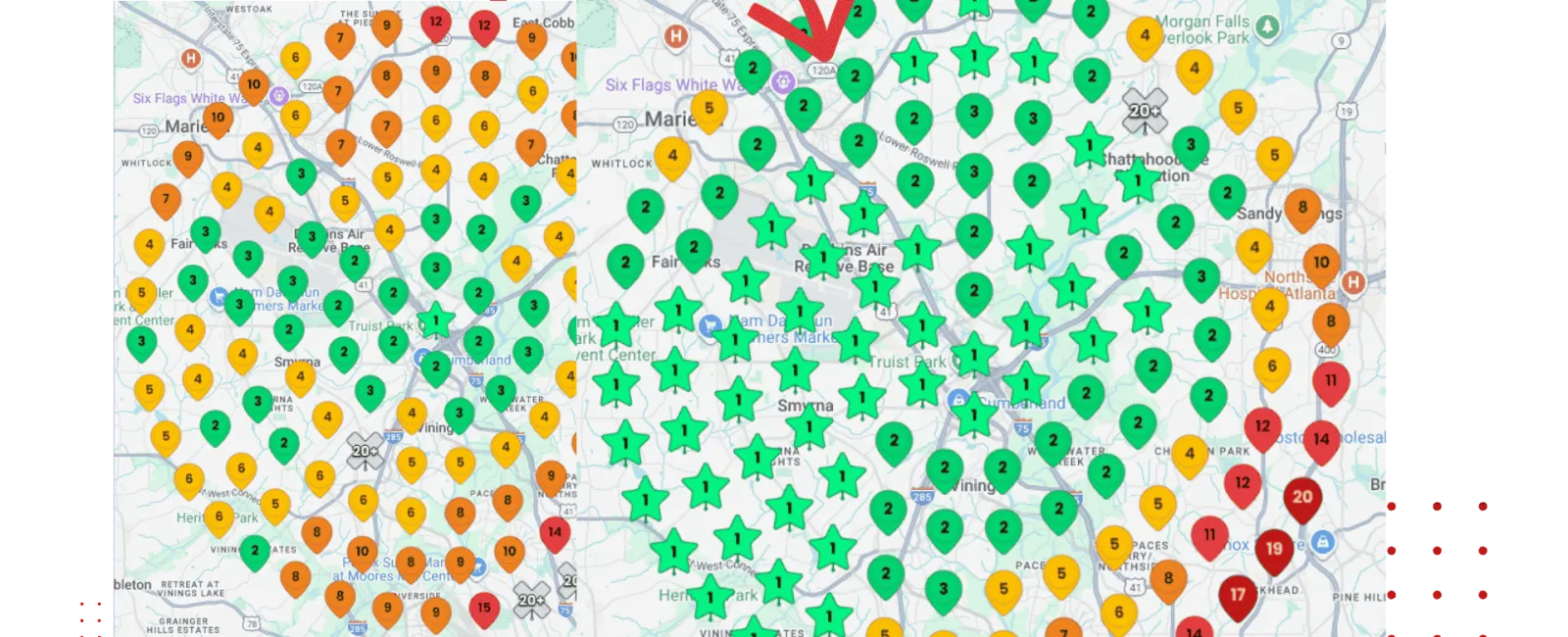
A #1 ranking in Google Maps can be the difference between zero leads and tens of thousands of dollars each month.
For RedBrick clients (and the home service market broadly), the dollar value of a #1 Google Maps "Map Pack" ranking is best treated as a demand-capture model: you're not "creating" demand, you're capturing a disproportionate share of existing, local, high-intent searches that already convert into calls and booked jobs.
A #1 Google Maps ranking doesn't create demand. It captures a disproportionate share of local, high-intent searches that already convert into calls and booked jobs. The real question isn't whether Map Pack visibility matters. It's how much revenue that position can put on the table, and what levers control the outcome. This article breaks the math wide open.
The Revenue Model: Six Trades, One Framework
Every estimate in this article follows one core formula. We take a keyword basket of high-intent, service-related search queries per trade, scale them to a representative mid-sized metro using population share, then layer on Map Pack click-through rates, real-world conversion benchmarks, and trade-specific job values.
The representative metro used here is the Richmond, VA MSA: roughly 1.35 to 1.37 million residents, depending on dataset and year. US population for scaling is approximately 341.8 million (July 2025 estimate). If you want to apply this to your own market, swap in your metro population and the math updates automatically.
      // Step 1: Scale national search volume to your metro

      MetroVol = USVol × (MetroPop / USPop)


      // Step 2: Estimate clicks to the #1 Map Pack listing

      MonthlyClicks = MetroVol × CTR₁


      // Step 3: Convert clicks into booked jobs

      MonthlyJobs = MonthlyClicks × ConvRate


      // Step 4: Translate jobs into gross revenue

      MonthlyRevenue = MonthlyJobs × AOV
Each variable is sourced from a specific category of public data. Search volumes come from published keyword metrics (Ahrefs, SEMrush, and comparable SEO toolsets). CTR benchmarks are grounded in Backlinko's large-scale user behavior study, which reports that roughly 42% of local searchers click on results inside the Map Pack, and BrightLocal's local search research covering click-share dynamics. For the #1 listing specifically, we model a median CTR of 17.6%, with sensitivity from 15% to 20%.
Conversion rates (click to booked job) are the hardest variable to pin down because they depend on operational factors like call answer rate, speed-to-lead, and scheduling efficiency. We use blended ranges informed by ServiceTitan's published KPI benchmarks and call-tracking research demonstrating the revenue impact of missed calls. Average job values (AOV) are anchored in Angi's cost datasets, ServiceTitan ticket benchmarks, and JLC's Cost vs. Value remodeling reports.
Monthly Revenue Estimates by Trade
Here's what the model produces for a Richmond-scale metro. Each card shows the median monthly revenue the #1 Map Pack listing is modeled to capture, with the full low-to-high range underneath.
These are gross revenue estimates from incremental bookings attributable to the #1 Map Pack position, not profit, and not guaranteed outcomes. The ranges are wide on purpose: they show how sensitive the result is to your conversion rate and service mix. The goal is a transparent model you can recalibrate, not a promise.
The Full Input Table
Transparency matters. Here's every input feeding the model: keyword basket size, metro-scaled search volume, CTR assumptions, conversion range, and AOV range per trade.
| Trade | US Monthly Searches | Metro Searches (L/M/H) | #1 CTR (L/M/H) | Click→Book (L/M/H) | AOV (L/M/H) | Revenue (L/M/H) |
|---|---|---|---|---|---|---|
| Plumbing | 612,100 | 2,208 / 2,454 / 2,699 | 15% / 17.6% / 20% | 6% / 8% / 12% | $400 / $900 / $2,500 | $8K / $31K / $162K |
| HVAC | 624,300 | 2,259 / 2,503 / 2,754 | 15% / 17.6% / 20% | 5% / 7% / 10% | $300 / $1,200 / $5,000 | $5K / $37K / $275K |
| Roofing | 386,600 | 1,395 / 1,550 / 1,705 | 15% / 17.6% / 20% | 3% / 5% / 8% | $700 / $6,500 / $15,000 | $4K / $89K / $409K |
| Landscaping | 340,700 | 1,230 / 1,366 / 1,502 | 15% / 17.6% / 20% | 2% / 4% / 7% | $200 / $1,500 / $6,000 | $700 / $14K / $126K |
| Int. Remodeling | 199,000 | 718 / 798 / 878 | 15% / 17.6% / 20% | 1.5% / 2.5% / 5% | $10K / $25K / $60K | $16K / $88K / $527K |
| Electrical | 261,200 | 943 / 1,047 / 1,152 | 15% / 17.6% / 20% | 4% / 8% / 12% | $300 / $1K / $3,500 | $1.7K / $15K / $97K |
Where the Inputs Come From (Trade by Trade)
Search Volume
Each trade uses a "keyword basket" approach: we sum several high-intent, service-oriented queries (typically "[service] near me" plus core service terms) using publicly reported US monthly volumes from major SEO tool providers, then scale to the metro by population share. This is intentionally transparent. If you have metro-specific Google Keyword Planner exports, swap them in and everything downstream recalculates.
Map Pack CTR
Backlinko's user behavior study found roughly 42% of local searchers click inside the Map Pack. For the #1 position specifically, we use a 17.6% median CTR (with 15% and 20% as the low and high bounds). BrightLocal has also documented how click-share shifts when Local Services Ads appear on the page, which is why sensitivity ranges matter.
Conversion Rates
There is no universal "official" conversion rate for Map Pack clicks. Conversion depends on how fast you answer the phone, how well you handle the intake, your pricing transparency, and your online reputation. We model it as a blended click-to-booked-job rate using ranges consistent with ServiceTitan's published call booking benchmarks and call-tracking research that ties missed calls directly to lost revenue. Urgent "fix-it-now" trades (plumbing, electrical) convert at the high end. Longer-consideration projects (remodeling, landscaping design/build) sit lower.
Average Job Values
AOV ranges are grounded in three primary sources: Angi's published repair vs. replacement vs. project install pricing data, ServiceTitan's KPI and ticket benchmarks for service and replacement work, and JLC's Cost vs. Value dataset for remodeling project tiers.
Trade-specific highlights worth noting:
- Plumbing: A realistic "mix" AOV is much higher than a basic $150 service call once you account for water heater replacements, repipes, and sewer work.
- HVAC: Replacement economics alone carry the model. A single system replacement often runs into the thousands.
- Roofing: Wide AOV swings (materials, complexity, tear-off, decking) are why roofing shows extreme revenue sensitivity to small conversion changes.
- Landscaping: Bimodal distribution. Monthly maintenance is small-ticket; design/build projects can be an order of magnitude larger.
- Interior Remodeling: Kitchen and bath remodels, additions, and major renovations push project costs into five and even six figures. The spread is real.
- Electrical: The gap between a basic outlet repair and a full panel upgrade, EV charger install, or generator hookup creates meaningful AOV swing.
Sensitivity Analysis: What Moves the Needle Most?
A #1 Map Pack ranking is unusually sensitive to three variables: CTR to the #1 listing (driven by SERP layout, brand signals, and review count), click-to-booked-job conversion (driven by operations, speed-to-lead, and trust), and AOV/service mix (repair-heavy vs. replacement-heavy, residential vs. commercial).
The chart below holds metro search volume and CTR constant at the median settings, then shows how monthly revenue scales as the click-to-booked-job conversion rate moves from 2% to 12%.
Revenue vs. Click-to-Book Rate (Median CTR & AOV)
What this chart tells you in plain terms: Roofing and remodeling look dramatic because the ticket is large. A small change in booked jobs produces a massive revenue delta. Plumbing, HVAC, and electrical are more dependent on operational conversion (answering, booking, dispatch, financing options) because many jobs are moderate-ticket unless you lean into replacements and upgrades. Landscaping is the most polarized: monthly maintenance yields smaller tickets, but design/build projects can dwarf them, so your actual outcome depends on whether you market and sell installs vs. maintenance.
Operations (answering the phone and booking the job) can be just as valuable as the ranking itself. Call-tracking research consistently shows that missed calls and weak booking rates suppress the revenue payoff of visibility. If you rank #1 but miss 30% of calls, you're leaving money on the table that no amount of SEO can recoup.
How to Maximize Map Pack Value
A #1 ranking is not a finish line. It's a conversion surface. Two companies with similar visibility can produce radically different revenue based on trust signals, response time, and booking discipline.
GBP Optimization Checklist
- Align to Google's three ranking primitives: relevance (accurate categories, services, content), distance (realistic service areas), and prominence (brand signals, reviews, citations, links).
- Build review velocity and response discipline: Consumers rely heavily on reviews when choosing local businesses, and they read owner responses. Review freshness expectations are tight.
- Improve listing conversion assets: High-quality imagery, accurate hours, a clean service list, and correct landing page mapping are all documented conversion factors in local SEO research.
Multi-Location Strategy: What Google Actually Allows
Many "2 to 4 profiles across a metro" strategies run afoul of Google's guidelines. If you're a service-area business, Google's documentation states you can only have one profile for the entire area you serve. If you have genuinely different staffed locations with separate service areas and teams, a profile per location is permitted, but it must represent real-world operations (with guidance like a roughly two-hour driving time rule of thumb for service areas). Google also states you should have only one profile per business, and duplicates can be removed from Search and Maps. The scalable strategy is multi-location done compliantly: true branches, true teams, not spammy duplicates.
KPI Tracking That Turns Rankings Into Revenue
- Track lead source and call quality: Call intelligence research shows Google Business Profile drives a material share of conversations and appointments for small businesses. Attribution is essential.
- Track booking performance: Typical call booking rates are far from 100%. Improving them is often the fastest ROI lever once visibility is in place.
- Track average ticket intentionally: Operational KPI frameworks treat average ticket as a core performance lever by role and trade. Know your number, and work to move it.
Key Takeaways
1. The value of #1 is a formula, not a mystery. It's (demand) × (CTR) × (conversion) × (ticket size). You can model it transparently with sourced inputs and adjust it for your metro.
2. Roofing and remodeling show the largest revenue swings because AOV ranges are wide. In these trades, small conversion deltas matter more than raw search volume.
3. Operations matter as much as rankings. Missed calls and weak booking rates suppress the payoff of visibility. Rank and convert, or rank and waste.
4. Multi-GBP strategies must follow Google's rules. Service-area businesses generally get one profile. Duplicates can be removed. Build real locations, not fake ones.
Want to Know What #1 Is Worth in Your Market?
We'll run this model with your metro, your trades, and your actual conversion data. Let's build a plan that turns Map Pack visibility into booked revenue.
Book a Free Strategy Call

