


Two companies we worked with had AI rebuild their websites this year to save money. Both are now losing the organic traffic they spent years earning.
I run a digital marketing agency, so yes, I have a dog in this fight. I also use Claude every single day, and I think it is one of the best tools my team has ever had. That is exactly why I want to walk you through what went wrong.
If you own a small or local business, you have probably heard the pitch already. A nephew, an office manager, or someone in your networking group said it: "Why are you paying for a website? Just have Claude build it." Here is what that advice leaves out.
Two former clients, two charts
Both companies left us to cut costs, and both had Claude rebuild their sites. I am not naming them, because this is not about embarrassing anyone. The numbers below are Ahrefs estimates of organic search traffic, pulled October 13, 2026.
Peak before the drop |
Today |
Change |
|
|---|---|---|---|
Site one: estimated monthly organic traffic |
About 47 (early August) |
About 6 |
Down roughly 85% |
Site one: pages ranking in Google |
About 17 |
About 8 |
Down roughly half |
Site two: estimated monthly organic traffic |
About 270 (late August) |
About 125 |
Down more than half |
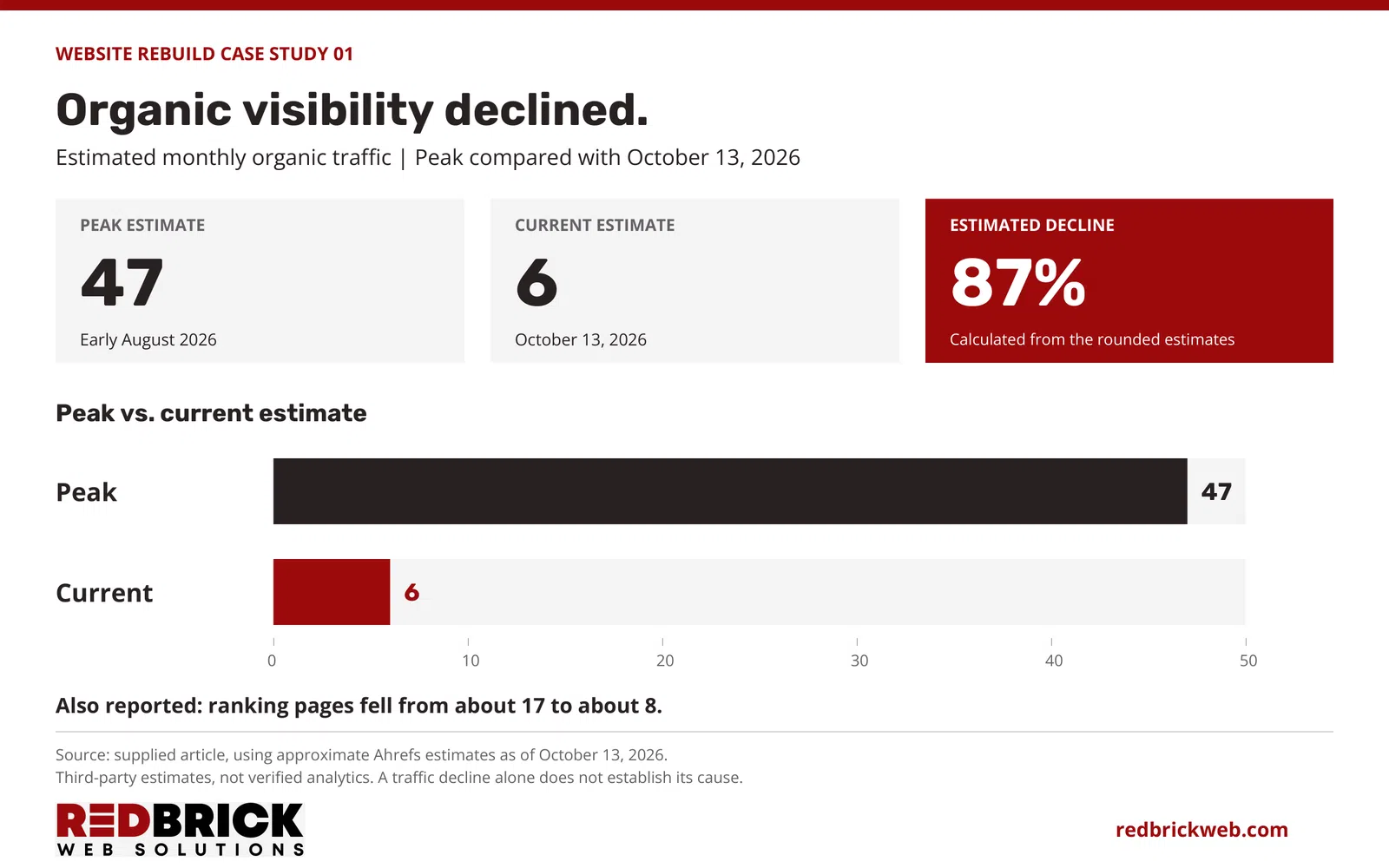
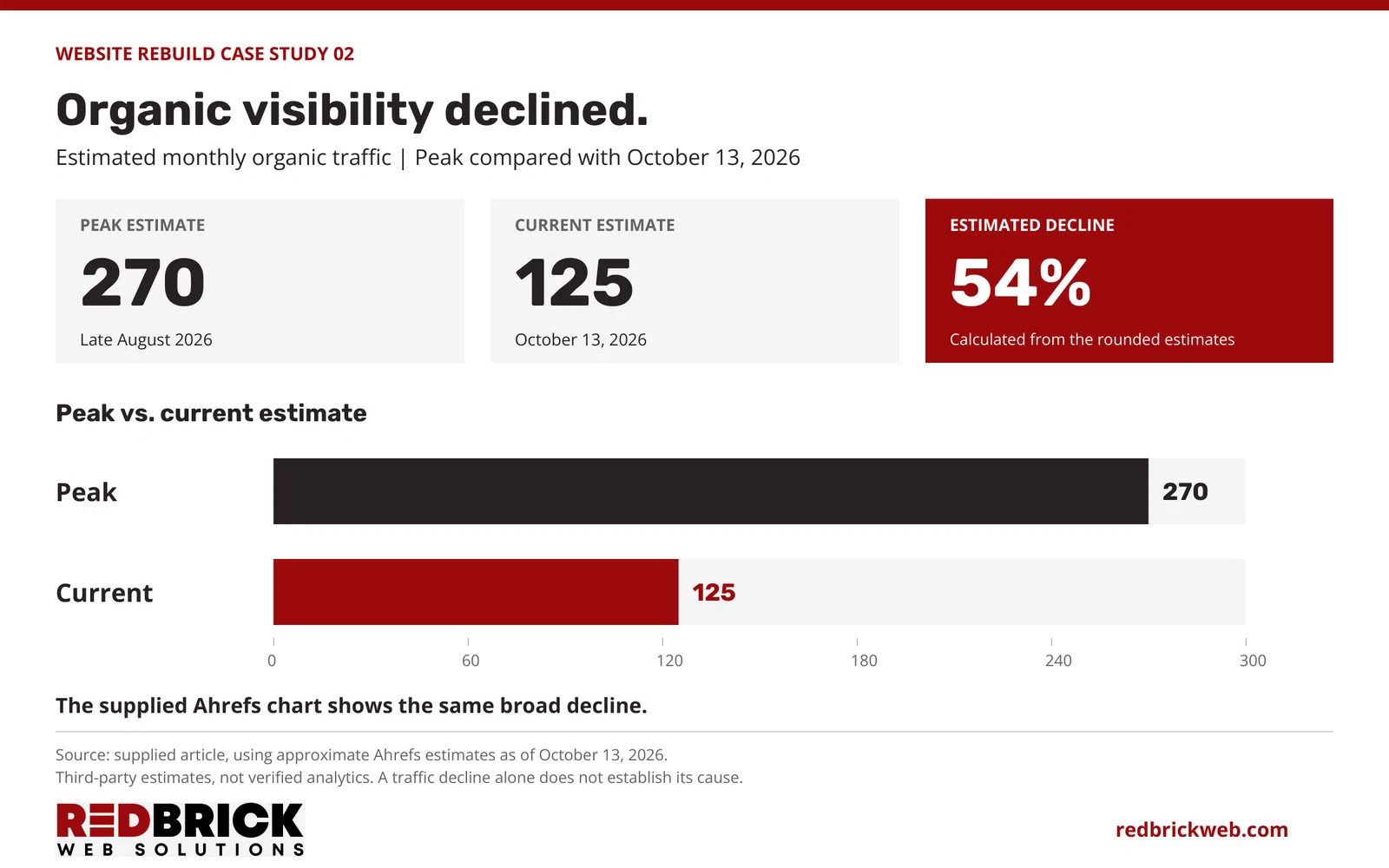
Look at the first chart closely. Traffic had been climbing since spring, the result of months of work finally compounding. Then it fell off a cliff, and the number of pages Google ranks fell with it.
Those raw numbers may look small to you. They are third-party estimates, not the companies' own analytics, and small business sites never post big numbers. You do not need ten thousand visitors. You need the neighbor with a real problem to find you instead of the other guy.
Why this hits small businesses harder
Local customers decide fast, and they do not look far. In BrightLocal's 2026 consumer search research, 52% of consumers started their most recent local search on Google. 75% picked a business in under 30 minutes, and 72% looked at three or fewer options.
Read that last number again. If a rebuild knocks you out of the top few results, most customers never learn you exist. They call someone else before lunch.
Four things make a bad rebuild more expensive for a small business than for a big one:
- You have no cushion. A national brand can lose 30% of its search traffic and survive on name recognition. You lose 30% and the phone gets quiet.
- Your rankings live in the small pages. The page for one service in one town is what wins "near me" searches. A rebuild tends to collapse twenty of those into a single "Services" page.
- Everything else points at your old URLs. Your Google Business Profile, directory listings, ads, and old social posts all link to specific pages. Change the addresses without redirects and those links break too.
- Nobody on staff is watching. You do not have a marketing department. By the time someone notices, the traffic has been gone for months.
What actually breaks
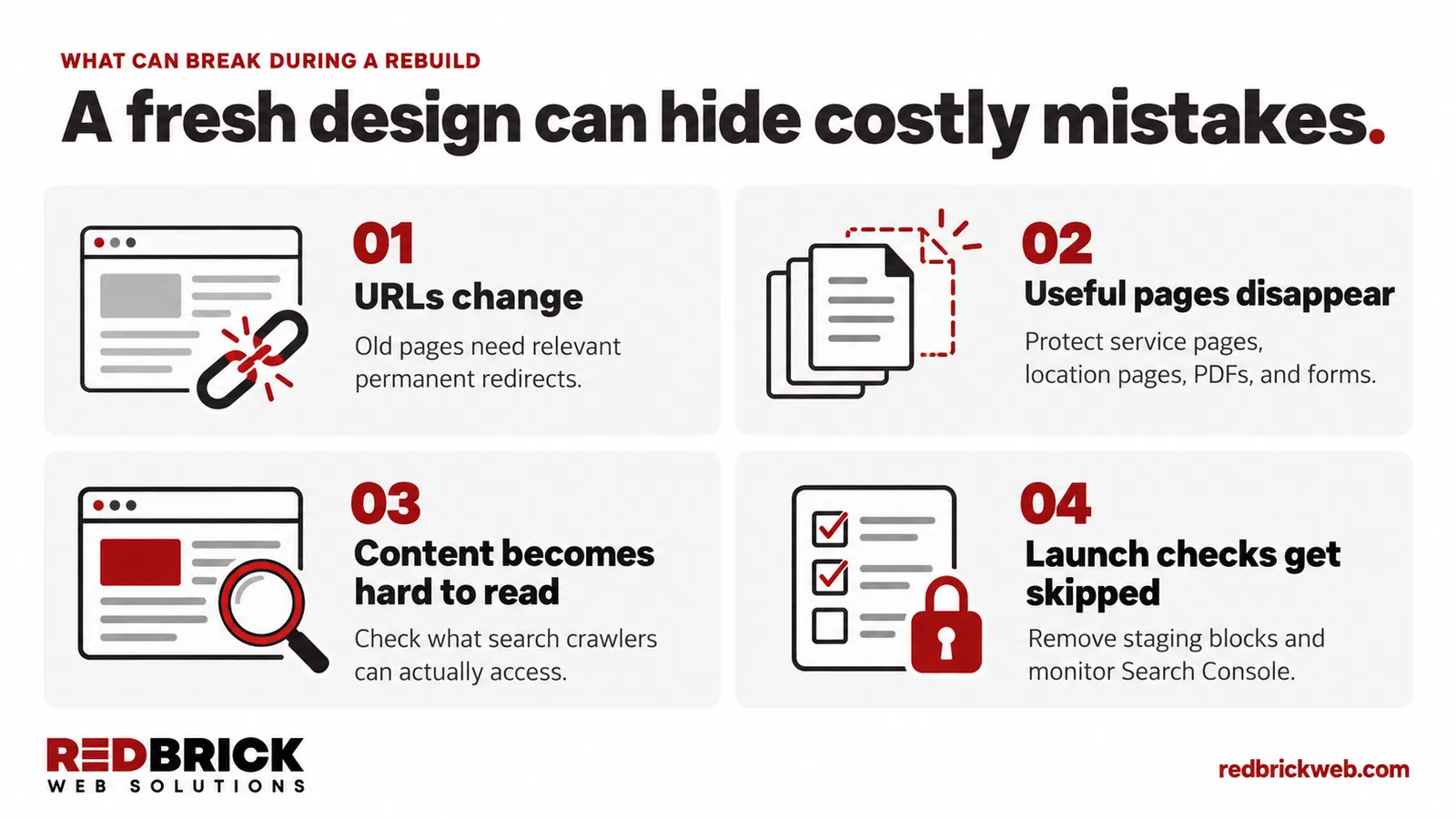
Claude did what it was asked: it built a clean, modern website. Nobody asked it to protect ten years of search equity, because the person typing the prompt did not know that was a job. Here are the failure points, most of them straight from Google's own documentation.
- The URLs change and nobody maps them. Google's site move guide says to map every old URL to its new one, use permanent server-side redirects, and keep them for at least a year. Skip that and every ranking page becomes a dead end.
- Everything gets pointed at the homepage. This is the lazy fix. Google warns that mass redirects to one irrelevant page can be treated as soft 404 errors, which means the old page's value is simply gone.
- Pages and files quietly disappear. A 60-page site becomes a sleek 8-page site. Google specifically says to move images and downloads such as PDFs, because they may already be earning traffic and links. For a local business, that is your menus, price sheets, forms, and service-area pages.
- The content only exists after JavaScript runs. AI tools often build sites as JavaScript apps, where the raw page is an empty shell. Google can render those pages, but it queues them, and it still recommends server-side or pre-rendering because not every bot runs JavaScript.
- AI search cannot read it at all. A Vercel and MERJ study from December 2024 found that none of the major AI crawlers, including OpenAI's and Anthropic's, rendered JavaScript. Crawlers change, so verify this for your own site. If it still holds, your new site is invisible to the tools your customers are starting to ask for recommendations. BrightLocal's 2026 review survey found 45% of consumers now use ChatGPT or similar AI tools to find local businesses.
- Staging settings ship to production. Google lists leftover noindex tags and robots.txt blocks among the most common migration mistakes. One forgotten line tells Google to drop the whole site.
- Everything changes at once. New design, new copy, new URLs, new platform, all on the same day. Google's advice is to change one thing at a time, so you can tell what caused a drop.
- Nobody is watching. The agency is gone, and nobody opens Search Console. The first warning is a quiet phone.
What the savings really cost
Search traffic does not snap back when you fix the mistake. Even for a move done correctly, Google says to expect rankings to fluctuate and a small or medium site to take a few weeks to settle.
Once traffic drops hard, the timeline gets ugly. SALT.agency studied 1,052 domain migrations in June 2026. Every site in the sample had lost 60% or more of its traffic. The median site took 304 days to get back to its old traffic, 42% took more than a year, and about 14% had not recovered after three years.
A fair caveat: that study covers moves to a new domain, which is a harder case than a rebuild on the same domain. I cite it because it is the best data I know of on what recovery looks like once Google loses the thread.
Now run your own math. Take what you saved by skipping a professional build. Compare it to a few missed calls a week, at your average ticket, for ten months. For most small businesses, that is not a close call.
To be fair: the tool is not the villain
Claude writes good code. My team uses it daily, and it makes us faster. Blaming it for these two charts would be like blaming a nail gun for a crooked wall when nobody checked the plans.
You would not hand a brand-new hire the best tools in the shop and send them to a customer's house alone. You would want a plan, a checklist, and someone experienced looking over the work. A website rebuild is the same. The tool does the building. Somebody still has to own the plan and the inspection.
And sometimes the DIY route is the right call. If your site has never ranked for anything and brings in no leads, there is no search equity to lose. Build it with AI, get it live, and improve from there. The danger is for the company whose site is already working harder than the owner realizes.
Before anyone rebuilds your site
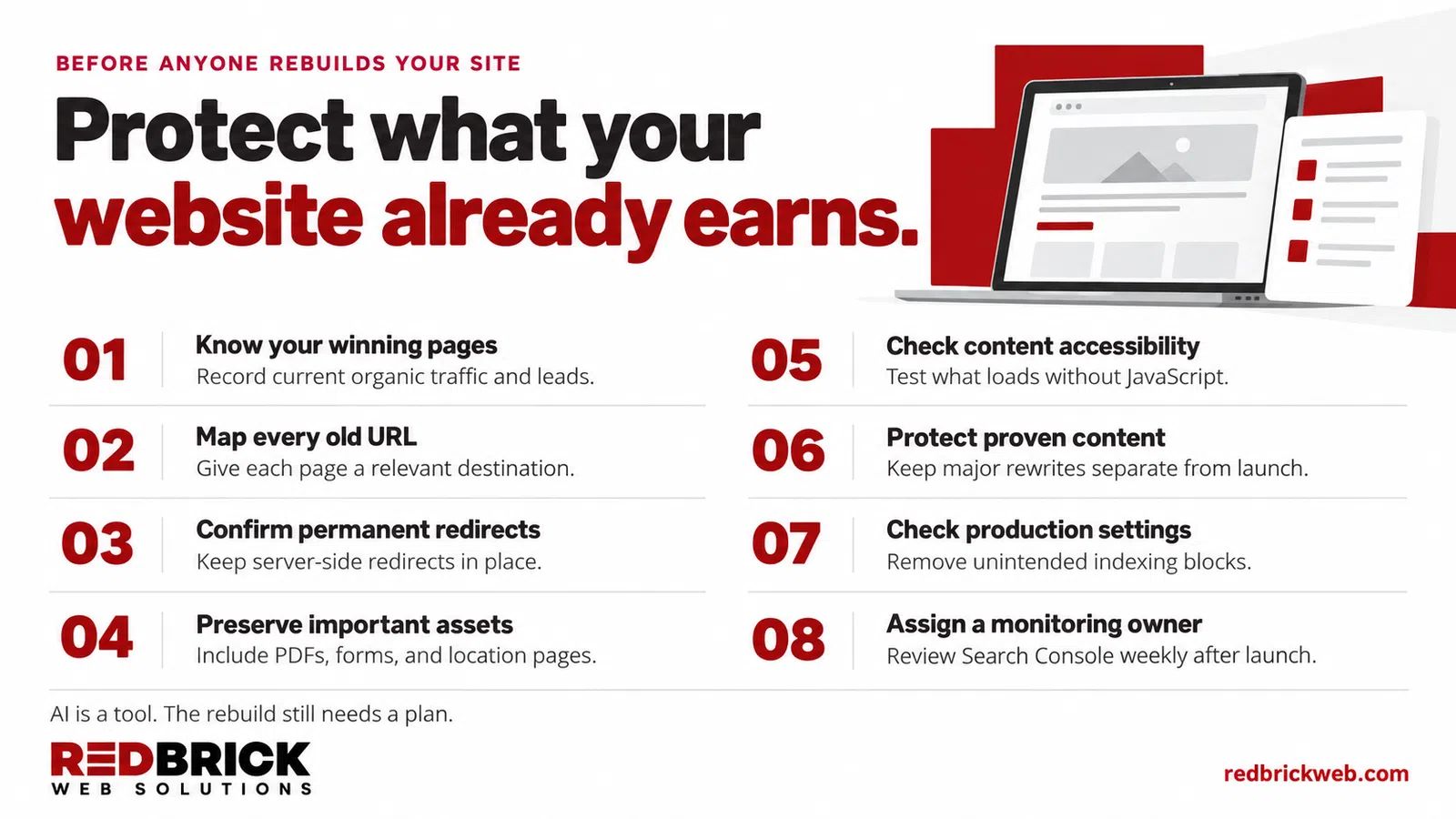
Whoever does the work, an agency, a freelancer, your IT person, or Claude, make them answer these eight questions first. If the answer to any of them is a blank stare, stop.
- Which pages bring in organic traffic and leads today? Pull it from Search Console and your analytics before a single page is touched.
- Where does every old URL go? You want a spreadsheet: old address, new address, one row per page.
- Are the redirects permanent and server-side? Ask for 301s, and ask who keeps them alive for at least a year.
- What happens to the PDFs, forms, and location pages? They need the same mapping as your pages.
- Can I read the page with JavaScript turned off? If the screen is blank, so is the page that many crawlers see.
- Is the copy on my best pages staying? Rewriting the words that rank is a separate project. Do not bundle it into launch day.
- Who removes the staging blocks at launch? Get a name, and have a second person check.
- Who watches Search Console for the 90 days after launch? Weekly, with authority to fix what they find.
None of this is exotic. It is the same care you already put into a job before you call it done.
The bottom line
Your website is not a brochure. It is the front door most of your customers walk through first, and it has been bringing them in for years. Rebuild it without a process and you change the address without telling anyone.
"Just have Claude build it" is a fine answer to the question "how do I get a nice-looking website cheap?" It is the wrong answer to "how do I keep the calls my current site is bringing in?" Those are two different questions, and the two charts above show what happens when you mix them up.
At RedBrick, we do not do long-term contracts, and you own everything we build. If you are planning a rebuild, with us, with someone else, or with AI, talk to us before launch day, not after. We would rather help you protect what you have than help you dig out. See how we approach web design and SEO.
Sources
- Google Search Central, How to move a site (last updated August 20, 2026): URL mapping, permanent redirects, one-year retention, soft 404 warning, common migration mistakes.
- Google Search Central, Understand the JavaScript SEO basics (last updated March 4, 2026): render queue, server-side rendering recommendation.
- Vercel and MERJ, The rise of the AI crawler (December 17, 2024): AI crawlers and JavaScript rendering.
- Dan Taylor, SALT.agency, Only 27% of domain migrations recover in 90 days (June 26, 2026): recovery timelines across 1,052 domain migrations.
- BrightLocal, Local SEO statistics, citing its 2026 Consumer Search Behavior Survey and 2026 Local Consumer Review Survey: where local searches start, how fast consumers decide, AI use for local recommendations.
- Traffic figures for the two sites: Ahrefs Site Explorer estimates, read from charts on October 13, 2026.

