


If you are asking "how do I grow my plumbing business?", the answer is rarely more emergency calls. It is predictable revenue from maintenance agreements, showing up first when a homeowner searches, and getting more profitable jobs out of every tech you already have.
Plumbing is a good business to be in. Demand is essential, the housing stock keeps aging, and there are not enough licensed plumbers to go around. That last point is also the catch: you cannot simply hire your way to growth. The shops that pull ahead do it with better systems and steadier revenue, not just more trucks.
Here are seven moves that work, in the order we would tackle them.
1. Build recurring revenue with maintenance agreements
Emergency repairs fill the schedule, but they create feast-or-famine cash flow. A maintenance plan evens it out. Members give you predictable revenue, stay with you longer, and call you first when the water heater finally fails.
A healthy base of agreements also makes your company worth more to a lender or a buyer, because the revenue does not depend on the phone ringing tomorrow.
What to do:
- Keep the plan simple. An annual whole-home plumbing inspection, a water heater flush, priority scheduling, and a discount on repairs.
- Offer it on every call. Give techs a short script and let customers sign up on a tablet before the truck leaves.
- Go after commercial and property management work. Backflow testing, compliance checks, and multi-unit maintenance are recurring by nature.
- Track it. Know what share of your revenue comes from agreements, and set a target to grow it each quarter.
2. Dominate local search
When a pipe bursts, nobody asks a neighbor for a referral. They search "plumber near me" and call one of the first three names they see. Showing up there is the single biggest growth lever most plumbing companies have.
This is the core of what we do in SEO for plumbing companies, and the fundamentals do not change.
What to do:
- Complete your Google Business Profile. The right categories, every service listed, accurate hours, and the same name, address, and phone number everywhere online.
- Post real job photos regularly. Your team, your trucks, and your work, not stock images.
- Get reviews every week. A text request sent right after a successful job is the easiest way to keep them coming.
- Build a page for every service. Emergency plumbing, water heaters, drain cleaning, sewer repair, and leak detection each deserve their own page.
- Build a page for every city and neighborhood you serve. That is how you rank outside the few miles around your office.
- Prepare for AI search. Homeowners increasingly ask AI tools who to call. Clear service pages, consistent listings, and strong reviews are what get you named.
Local SEO takes months to build, which is exactly why the plumbers who start now are hard to catch later.
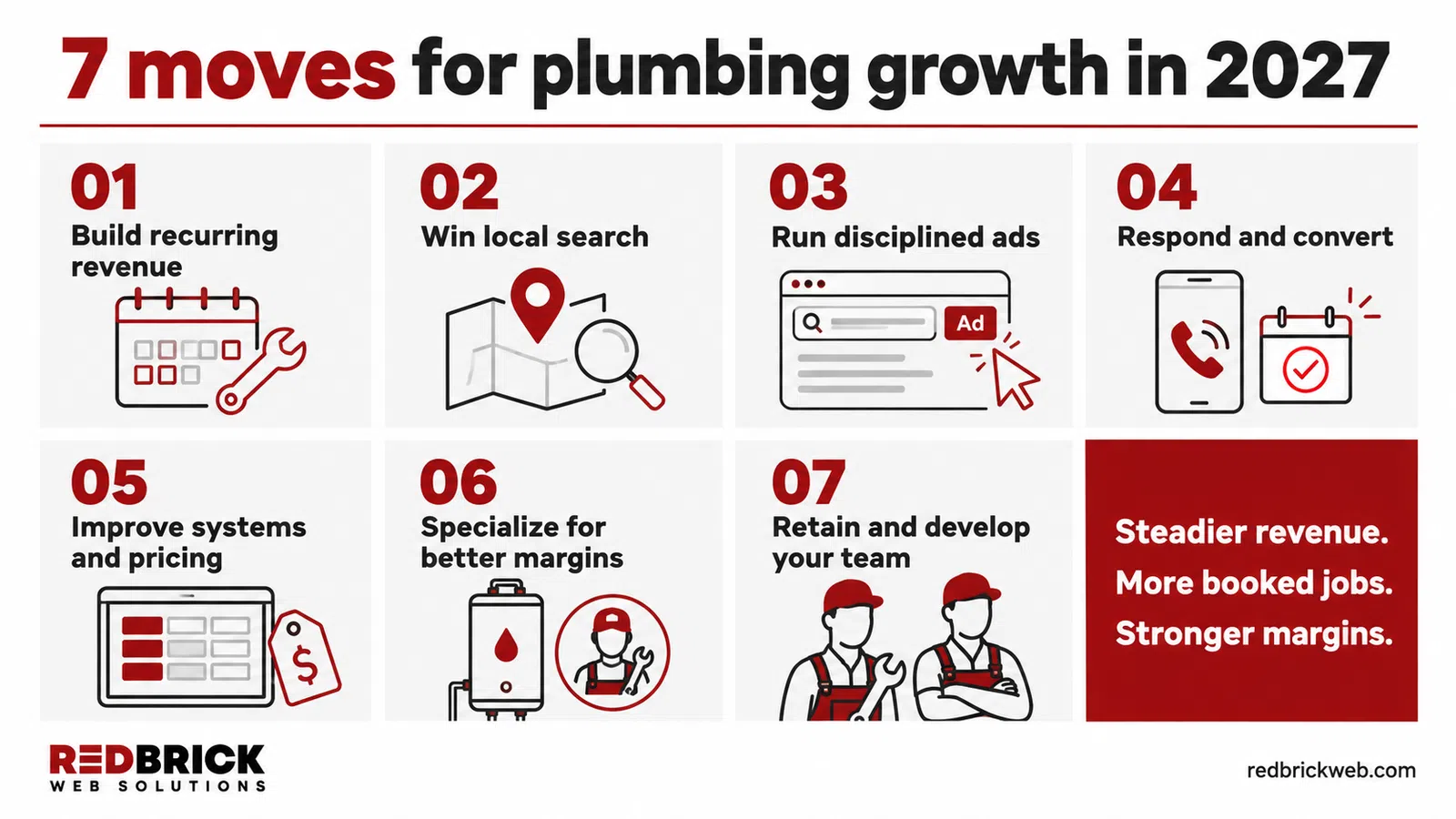
3. Run Local Services Ads and paid search with discipline
SEO builds the long-term asset. Paid search fills the schedule this week. Most growing plumbing companies need both.
Start with Google Local Services Ads. They appear at the very top of the results with a Google Verified badge, and you pay only when a customer contacts you, not for clicks. Google is also clear that businesses that regularly miss calls or ignore messages can see their ad ranking drop.
What to do:
- Get verified and stay responsive. Answer every LSA call and message, and keep your reviews strong.
- Dispute bad leads. Wrong service, wrong area, and spam should not come out of your budget.
- Add Google Ads for the jobs you want most. Water heater replacement, sewer line repair, and repipes justify a higher cost per lead than a clogged sink.
- Send each ad to a matching page. A tankless water heater ad should land on a tankless water heater page.
- Measure booked jobs and revenue, not clicks and impressions.
A well-run PPC program should be able to tell you what every booked job cost to acquire. If your current reporting cannot, that is the first thing to fix.
4. Answer every lead fast, on a website built to convert
Plumbing leads go cold in minutes. A homeowner with water on the floor calls the next company on the list the moment they hit voicemail. Every missed call is a job you paid to generate and then handed to a competitor.
Your website has the same job as your phone: turn a visitor with a problem into a booked appointment as quickly as possible.
What to do:
- Set up missed-call text-back. An instant "Sorry we missed you, how can we help?" recovers leads that would otherwise be gone.
- Cover after hours. Use an answering service or AI booking so a 10 p.m. emergency gets a response.
- Make calling effortless. A tap-to-call button at the top of every page on mobile.
- Offer online booking for non-emergency work.
- Show proof. Reviews, licenses, guarantees, and real photos near the top of the page.
- Keep the site fast. A slow site loses the visitor before they ever see your number.
Good web design for a plumbing company is judged by one thing: how many visitors become calls.
5. Raise productivity and margins with systems and pricing
When plumbers are hard to hire, growth has to come from more completed, profitable jobs per tech. That is a systems problem, not a hustle problem.
What to do:
- Run on field service software. Scheduling, dispatch, mobile quoting and signing, and invoicing in one platform cuts office work and adds jobs per day.
- Price from your real costs. Materials, labor, overhead, and the margin you want. Review your rates on a schedule, not when you feel squeezed.
- Offer financing on big tickets. Water heaters and repipes close more often when the customer sees a monthly payment.
- Upsell where it fits. Filtration, softeners, smart leak detection, and tankless conversions are natural add-ons during a service call.
- Watch five numbers: average ticket, gross margin by job type, callback rate, revenue per technician, and lead-to-booked-job conversion.
6. Specialize in higher-margin work
General repair means competing with every plumber in town on price. A specialty gives you better margins and a reason for customers to choose you.
Options worth a look:
- Tankless and high-efficiency water heaters.
- Trenchless sewer repair and hydro-jetting.
- Lead service line replacement, where local rules and mandates are driving demand.
- Water filtration, softening, and smart water monitoring, which can also become recurring revenue.
- Commercial and compliance work, such as backflow testing and property management contracts.
Pick one or two, get your team trained, and then market them hard. Each specialty deserves its own service page, its own reviews, and its own ad campaign, because each one is a different search.
7. Handle the labor shortage on purpose
The shortage of skilled plumbers is structural. The Bureau of Labor Statistics projects about 42,000 openings for plumbers, pipefitters, and steamfitters every year through 2035, many of them to replace people who retire or leave the trade.
You will not out-recruit that. You can become the shop good plumbers do not want to leave.
What to do:
- Retain first. Competitive pay, benefits, a clear path from apprentice to lead, and a culture worth staying for.
- Give techs good tools. Better scheduling and software mean more finished jobs without burnout, and that makes you easier to recruit for.
- Start an apprenticeship pipeline. It takes four to five years to make a journey-level plumber, so begin now.
- Document your processes. Growth without written systems turns into chaos.
- Add trucks only when the current ones are full and your cash flow supports it.
Choosing a marketing partner for your plumbing company
Moves two, three, and four are where most plumbing owners bring in help, and where many have been burned before. Ask any agency these four questions before you sign:
- Who owns the website, the ad accounts, and the data? If the answer is not you, keep looking.
- How long is the contract? A good agency keeps clients with results, not paperwork.
- What do the reports measure? Rankings and clicks are not booked jobs.
- Do they know home services? Emergency search behavior, service areas, and Local Services Ads are their own discipline.
RedBrick Web Solutions was built around those answers. We call it the anti-agency approach:
- No long-term contracts. We earn your business every month.
- You own everything. Your site, your ad accounts, and your data stay yours.
- Reporting tied to outcomes. We report on what the marketing produced, not vanity metrics.
- Home services is our specialty. SEO, PPC, and web design for contractors and franchise brands, including a dedicated plumbing SEO program.
Where to start
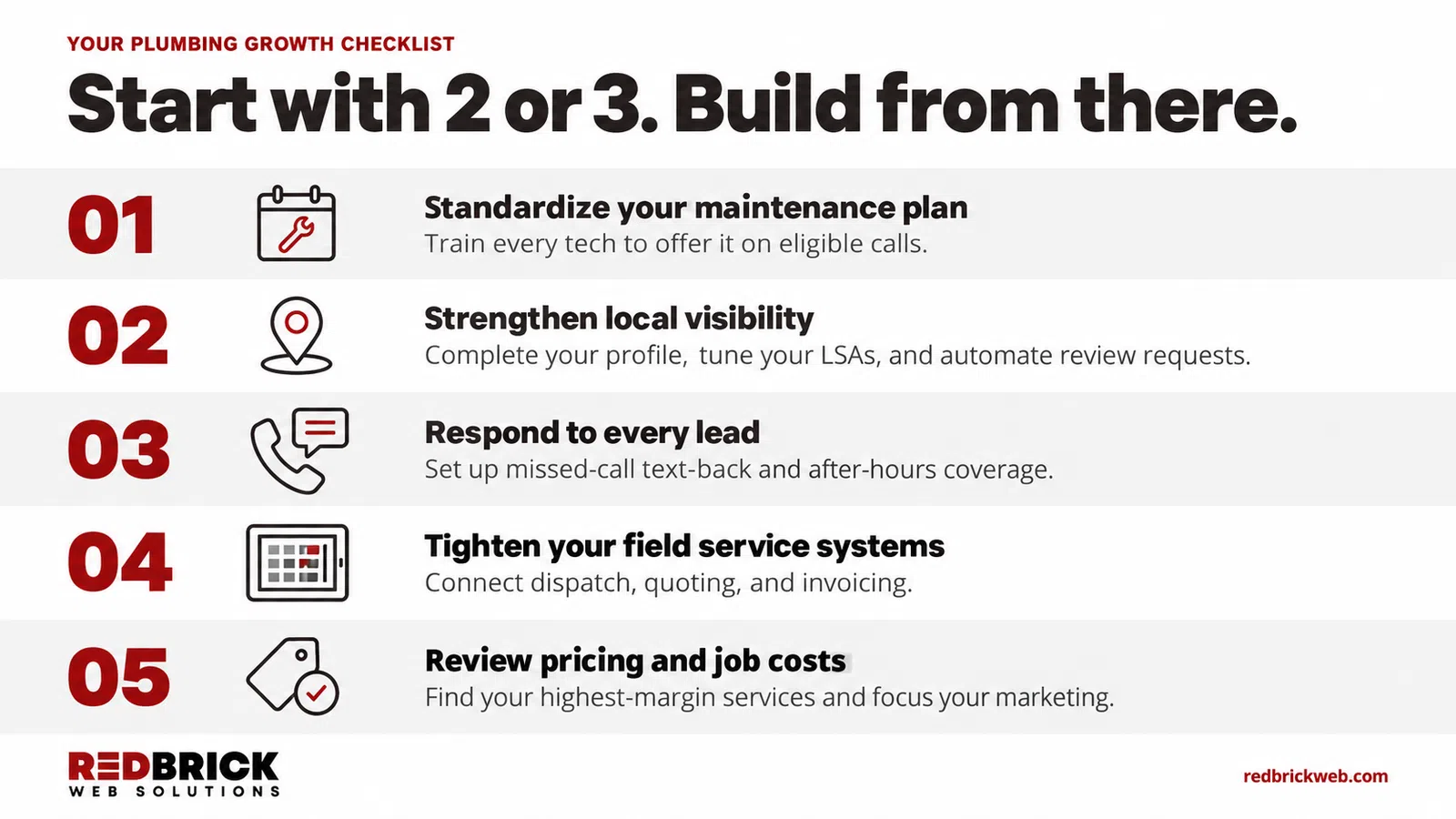
Pick two or three of these and do them well before adding more:
- Standardize one maintenance plan and train every tech to offer it on every eligible call.
- Complete your Google Business Profile, launch or tune up Local Services Ads, and automate review requests.
- Set up missed-call text-back and after-hours lead handling.
- Tighten your field service software for dispatch, quoting, and invoicing.
- Review pricing and job costing on recent work, and find the highest-margin services to push.
Before you change anything, write down your baseline: leads, close rate, average ticket, recurring revenue share, and revenue per tech. Growth compounds when all five move together, and you can only see that if you measured where you started.
Ready to grow your plumbing business? Talk to RedBrick Web Solutions about your local search presence. No long-term contract, and everything we build is yours.


