

The most expensive thing in your business might be the quotes you never follow up on.
Here's the pattern we see constantly with home services contractors. You drive out to the house, walk the job, do the estimate, and send the quote. And then... nothing. If the homeowner doesn't call back, the file dies in the truck.
That quote cost you real money. Between the marketing spend that generated the lead, the fuel, and the hours of drive and site time, a single estimate can easily represent $150 to $300 in sunk cost before you've earned a dime. If you want to improve your lead follow-up process, the first step is admitting that "we never heard back" is not a lead problem. It's a follow-up problem.
Why Your Lead Follow-Up Process Breaks Down
Most contractors don't have a lead follow-up process. They have a hope. Send the quote, hope the phone rings.
But homeowners rarely go quiet because they hated your price. They go quiet because life gets in the way. They're collecting two more bids. They're waiting on a spouse. They're unsure about financing. They forgot which contractor was which.
None of those are lost jobs. They're stalled jobs. And a stalled job goes to whichever contractor shows up in the homeowner's inbox or text thread while they're still deciding.
The Math Behind Lead Follow-Up
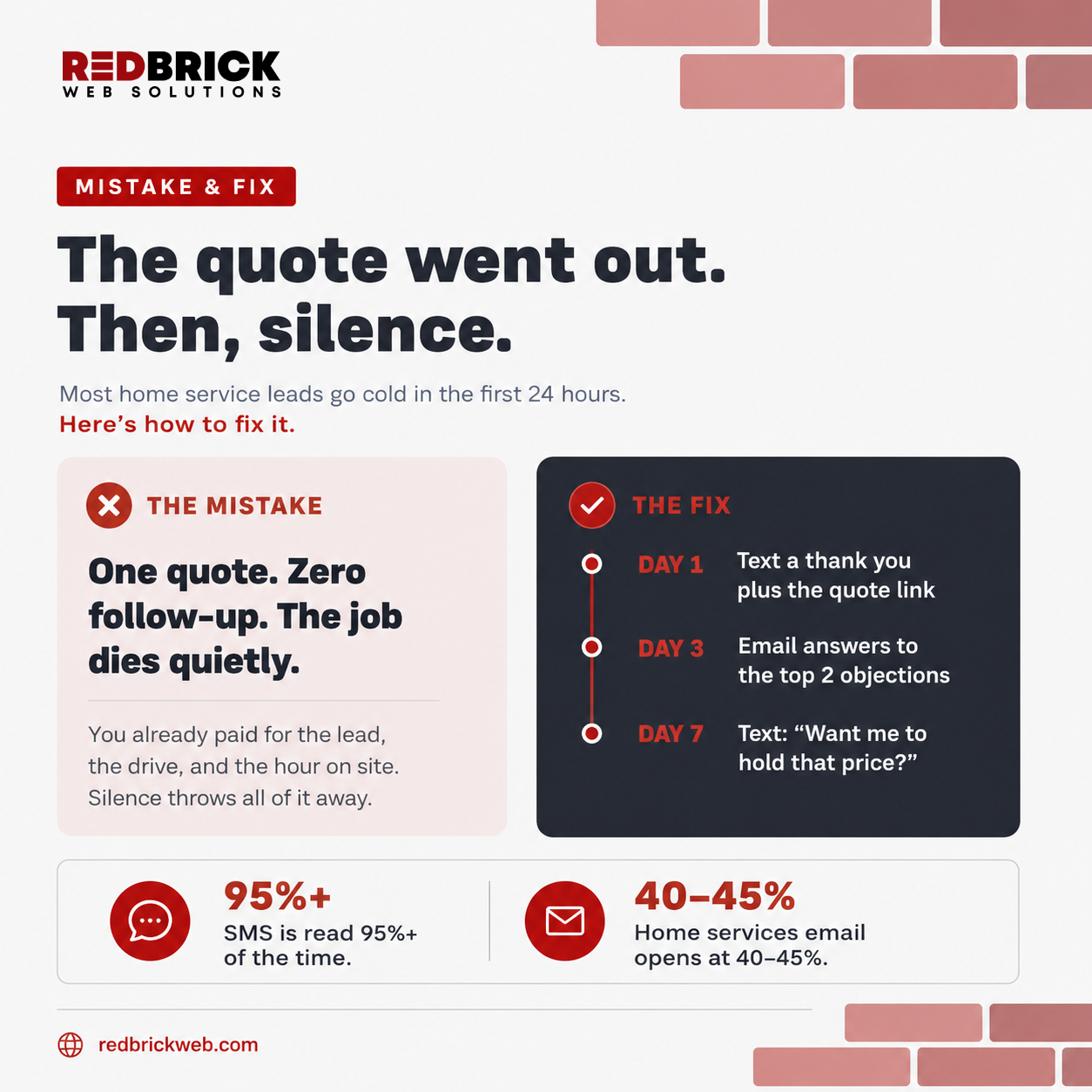
The follow-up that rescues a dead quote costs almost nothing, and the channels are wide open. In home services, email consistently runs a 40 to 45 percent open rate, well above average for most industries. SMS is even better: text messages get read more than 95 percent of the time, usually within minutes.
Compare that to the cost of generating a brand new lead. Following up on an existing quote is the cheapest revenue in your entire business. You already paid to get in front of this homeowner. The only question is whether you stay there.
How to Follow Up With Leads: The 3-Touch System
You don't need a complicated nurture campaign. You need a simple lead follow-up system with three touches, mostly automated:
Day 1: Text a thank you plus the quote link. Same day as the estimate. "Thanks for having me out today. Here's your quote so it's easy to find: [link]. Any questions, just reply here." You've now planted your quote in the one place they actually look.
Day 3: Send a follow-up email answering the two most common objections. Every contractor knows the two questions that stall their deals. Usually it's price justification and timeline. Write one email that answers both before the homeowner has to ask: why your quote includes what it includes, and what scheduling looks like if they start this month.
Day 7: Text one simple question. "Want me to hold that price through Friday?" One sentence. It creates a soft deadline, gives them an easy reason to reply, and reopens the conversation without pressure.
Three touches. Two texts, one email. Set it up once in your CRM or field service software, and it runs on every quote automatically.
What an Improved Follow-Up Process Is Worth
Say you run 20 estimates a month and close 30 percent on the first pass. That leaves 14 open quotes. If your lead follow-up system rescues even 2 of them at an average ticket of $5,000, that's $10,000 a month in revenue you were already paying for and just not collecting. Over a year, that's a six-figure difference from two text messages and an email.
No new ad spend. No new leads. Just finishing the sales process you already started.
Stop Letting Silence Close Your Deals
The contractors who win in competitive markets aren't always the cheapest or the best marketers. They're the ones who follow up when everyone else goes dark. A quote without follow-up isn't a sales process. It's a donation to the competitor who texts back.
So here's the question worth asking today: how many open quotes are sitting in your truck right now?
If the honest answer is "I don't know," that's fixable. At RedBrick, we help home services contractors build marketing systems that don't just generate leads but actually convert them, from the first click to the signed contract. No long-term contracts, and you own everything we build.


